Italian Food Watercolor Clipart: A Practical Resource for Culinary Design
In the crowded landscape of digital design assets, finding illustrations that balance artistic charm with technical precision can be a challenge. Italian Food Watercolor Clipart has emerged as a specific niche resource that appeals to a wide range of creators, from professional graphic designers to hobbyist crafters. This collection focuses on hand-painted representations of iconic Italian dishes, offering a visual language that is both warm and inviting. For those working on food-related projects, understanding the utility and quality of these assets is essential before integrating them into a workflow.
The appeal of watercolor aesthetics lies in their organic texture and soft edges, which contrast sharply with the rigid lines of vector graphics or flat digital illustrations. When applied to culinary subjects like pizza, lasagna, and ravioli, this style evokes a sense of homemade authenticity and tradition. This article evaluates the practical value of such clipart sets, examining their technical specifications, versatility across different media, and suitability for various professional and personal projects.
Technical Specifications and Quality Standards
When evaluating digital assets, the first consideration must always be technical quality. A typical high-quality set of Italian Food Watercolor Clipart includes files formatted as PNGs with transparent backgrounds. This transparency is critical for usability, allowing designers to layer images over various backgrounds without unsightly white boxes or complex masking processes.
Resolution is another key factor. Professional-grade clipart should offer a resolution of at least 300 DPI (dots per inch). This standard ensures that the images remain crisp and clear when printed, whether on small recipe cards or larger poster formats. For instance, a file size of 3500 x 3500 pixels provides ample room for scaling down without losing detail, though upscaling beyond the original dimensions may result in pixelation. Creators should verify that the watercolor textures retain their subtle gradients and brushstroke details at this resolution, as compression artifacts can ruin the delicate nature of watercolor art.
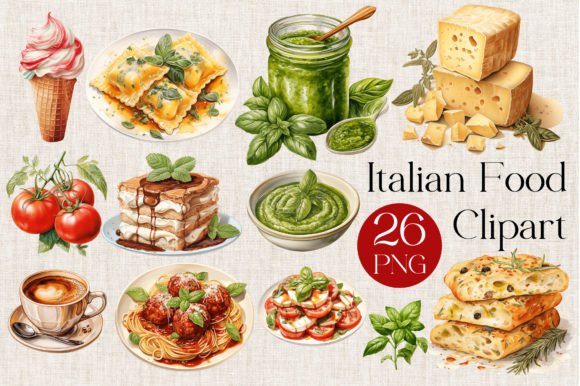
A comprehensive collection usually contains around 26 distinct illustrations. This number offers enough variety to cover major Italian staples—such as margherita pizza, spaghetti carbonara, tiramisu, and antipasto platters—without overwhelming the user with redundant variations. The consistency in style across all items in the pack is vital; mismatched lighting or differing levels of saturation between images can disrupt the visual cohesion of a final design.
Versatility in Professional and Personal Projects
The primary strength of Italian Food Watercolor Clipart is its adaptability. Unlike photorealistic stock photography, which can sometimes feel sterile or overly commercial, watercolor illustrations add a human touch. This makes them particularly effective for brands aiming to project warmth, artisanal quality, or family-oriented values.
Marketing and Branding Materials
For restaurant owners, caterers, and food bloggers, these graphics serve as excellent elements for social media posts, menu designs, and promotional flyers. A watercolor illustration of a steaming bowl of pasta can soften the look of a digital advertisement, making it feel more approachable. Small business owners often use these assets to create cohesive branding kits that stand out from competitors relying on generic icon sets.
Print-on-Demand and Product Design
Entrepreneurs in the print-on-demand sector find significant value in these cliparts. They can be applied to aprons, tote bags, kitchen towels, and ceramic mugs. The transparent PNG format simplifies the process of placing designs on colored fabrics or products. However, designers must ensure that the color profile of the digital file matches the printing requirements of their chosen manufacturer to avoid color shifts.
Educational and Editorial Content
Educators and publishers creating materials about Italian culture, geography, or culinary history can use these illustrations to break up text and engage readers. In cookbooks or recipe blogs, watercolor images provide a decorative element that complements written instructions without distracting from the content. They are also suitable for creating visually appealing recipe cards, where space is limited and clarity is paramount.
User Experience and Workflow Integration
From a usability perspective, well-organized clipart sets save time. Designers appreciate when files are named logically and grouped by category. The ability to drag and drop high-resolution PNGs directly into software like Adobe Photoshop, Illustrator, Canva, or Procreate streamlines the creative process. For non-designers, such as scrapbookers or journal enthusiasts, the ease of use is even more critical. These users often lack advanced editing skills, so assets that require minimal adjustment are highly valued.
The "hand-painted" aesthetic implies a certain level of imperfection, which is part of its charm. However, this also means that each piece is unique. Users should not expect perfect symmetry or uniform shapes, as this would contradict the medium’s nature. Instead, the value lies in the expressive brushstrokes and the interplay of light and shadow that mimic traditional painting techniques.
Target Audience and Ideal Use Cases
Who benefits most from Italian Food Watercolor Clipart? The audience is broad but shares a common need for visually appealing, theme-specific imagery.
- Graphic Designers: Looking for quick, high-quality elements to enhance client projects related to food and hospitality.
- Small Business Owners: Needing affordable branding assets for cafes, pizzerias, or gourmet food shops.
- Content Creators: Bloggers and influencers who want to maintain a consistent aesthetic across their digital platforms.
- Hobbyists: Individuals engaged in scrapbooking, junk journaling, or card making who seek thematic decorations.
- Educators: Teachers creating engaging materials for language or cultural studies classes.
In each of these scenarios, the clipart serves as a visual shorthand for "Italian cuisine," instantly communicating the theme to the viewer. The emotional resonance of watercolor—often associated with nostalgia and comfort—aligns well with the perception of Italian food as hearty and welcoming.
Limitations and Considerations
While versatile, watercolor clipart is not a universal solution. Its soft, diffuse style may not suit brands that require a sleek, modern, or high-tech image. Additionally, because watercolor relies on subtle color transitions, these images may not reproduce well on low-quality printers or dark backgrounds without proper preparation. Designers should test prints beforehand to ensure the colors remain vibrant and the details do not muddy.
Another limitation is specificity. A general "pizza" illustration may not accurately represent a specific regional variant or a proprietary recipe. For businesses with highly specialized menus, custom illustrations might be necessary. However, for general representation, a well-curated clipart set provides an efficient and cost-effective alternative.
Final Thoughts on Value and Application
Investing in a high-quality set of Italian Food Watercolor Clipart offers long-term value for creators who frequently work with culinary themes. The combination of artistic appeal and technical reliability makes these assets a practical addition to any digital library. By choosing files with transparent backgrounds and high resolution, users ensure flexibility across both digital and print media.
Ultimately, the decision to use these graphics should depend on the desired tone of the project. If the goal is to evoke warmth, tradition, and artisanal quality, watercolor illustrations are an excellent choice. They allow creators to infuse their work with a touch of Italian flair without the complexity of commissioning custom artwork. Whether for a professional marketing campaign or a personal scrapbook, these images provide a delicious visual element that enhances the overall narrative.
For those ready to elevate their designs, selecting a reputable source for these cliparts is crucial. Look for providers who offer clear licensing terms, high-resolution downloads, and responsive support. With the right assets, integrating the savory allure of Italian food into your creative projects becomes a seamless and rewarding experience.